It is 3:15 AM on a Thursday morning in May 2026. In a dimly lit home office, a traditional SEO specialist is frantically staring at a multi-tabbed spreadsheet. He is manually exporting keyword data from a premium SEO suite, copying search volume, manually tracking keyword difficulty, copying intent classification, and trying to paste it into an LLM interface to generate content. He runs into a context window error, his session times out, the formatting breaks, and he has to start all over again. He is exhausted, prone to human error, and fundamentally unscalable.
Meanwhile, three miles away, an autonomous server instance running a customized agentic workflow is completely silent. It doesn’t sleep. It doesn’t make formatting mistakes. Over the past six hours, this system—operating as a collection of specialized AI agents for SEO—has independently monitored a network of 50 enterprise content portals. It noticed a 4.2% drop in search impressions for a highly profitable commercial category.
Without human intervention, it initiated an automated response: it queried the Google Search Console API to isolate the exact decaying URLs, deployed a cluster of headless browsers to scrape the top 5 ranking competitors on the live SERP, performed a semantic vector distance analysis to find entity gaps, restructured the heading hierarchy of the underperforming pages, embedded dynamic internal links using calculated mathematical anchor text distributions, updated the local schema graphs, pushed the updates live via the WordPress REST API, and submitted an instant indexing request via the IndexNow protocol.
This is not a hypothetical vision of the future. This is the reality of search engine optimization in 2026. The era of traditional “Prompt Engineering”—where a human acts as the manual bridge between data and a static AI text box—is dead. If your SEO strategy relies on a human typing “Write a 1500-word article about X” into a web interface, you are bringing a wooden stick to a cybernetic drone war.
The year 2026 belongs to the AI-driven Systems Architect. SEO has evolved from a creative writing exercise into a rigorous data engineering pipeline. In this comprehensive, technical blueprint, we will dissect the exact architecture, code frameworks, deployment logic, and optimization strategies required to build, run, and scale autonomous AI agents for SEO that dominate both traditional search engines (Google, Bing) and next-generation Generative AI Search Engines (Perplexity, SearchGPT, OpenAI, Gemini).
1. Defining the Paradigm: Traditional AI SEO Tools vs. Autonomous AI Agents
To survive in the current search ecosystem, you must draw a hard line between legacy generative AI tools and true autonomous agentic systems. Using an AI tool requires constant human cognitive lifting. Using an AI agent requires only the definition of a high-level corporate objective and a strict set of boundary conditions.
Understanding this shift is critical for resource allocation. Let’s break down the technical differences across the architectural stack:
The Linear Trap of Legacy Tools
Legacy AI tools operate on a rigid, deterministic paradigm: Input $\rightarrow$ Processing $\rightarrow$ Output. You give the tool a keyword, it queries an internal static database or does a basic API call, and it spits out text. If the text is low quality, or if the keyword classification is wrong, the system cannot self-correct. The human must audit the output, realize it’s flawed, rewrite the prompt, and execute the cycle again. This creates a massive operational bottleneck, making it impossible to scale a web portfolio beyond a few dozen pages without linear increases in human payroll.
The Self-Correcting Loop of 2026 Agents
True AI agents for SEO operate on an agentic loop powered by advanced reasoning LLMs (such as Claude 3.5 Sonnet, GPT-4o, or deep-thinking open-source models like DeepSeek-R1 running locally). These agents possess agency, memory, tool access, and reflection capabilities. When given a goal—such as “Increase organic conversions for our financial vertical by 25% while maintaining a clean backlink-to-traffic ratio”—the agent treats it as an open-ended engineering problem. It breaks the objective down into a tree of sub-tasks, evaluates its own progress at each milestone, checks for logical fallacies, and loops back to try a different approach if its initial output fails to meet a strict programmatic rubric.
+------------------------------------------------------------+
|                  THE AGENTIC SEO LOOP                      |
+------------------------------------------------------------+
|                                                            |
|    [GOAL: Maximize Commercial Intent Rankings]             |
|                        │                                   |
|                        ▼                                   |
|           [Perceive SERP Landscape] <─────────────────+    |
|                        │                              │    |
|                        ▼                              │    |
|         [Plan Execution & Tool Selection]             │    |
|                        │                              │    |
|                        ▼                              │    |
|         [Execute Actions (Scrape/Code/Link)]          │    |
|                        │                              │    |
|                        ▼                              │    |
|         [Reflect & Audit Against Rubric] ─────────────+    |
|                        │ (If Failed)                       |
|                        │                                   |
|                        │ (If Passed)                       |
|                        ▼                                   |
|         [Deploy to CMS via REST API]                       |
|                                                            |
+------------------------------------------------------------+
2. The Core Architecture of an Enterprise SEO Agent
Building an enterprise-grade AI agent requires separate operational layers. You cannot simply drop code into a single file and expect it to manage a live web portfolio. The architecture must be modular, allowing for decoupled scaling of data ingestion, reasoning, and deployment.
A. The Data Perception Layer (The Input Gathering Engine)
The agent cannot make decisions in a vacuum; it must perceive the internet exactly as it exists in real-time. The Perception Layer connects to the data sources that matter:
- The Search Performance API: Connects directly to the Google Search Console API, pulling raw JSON payloads containing impressions, clicks, CTR, and average positions at the page-query level.
- The Backlink Core API: Connects to specialized SEO indexes (Ahrefs, Semrush, or custom open-source indexers) to pull anchor text densities, referring domain metrics, and live URL Rating fluctuations.
- The Live DOM Scraper: A cluster of headless browser nodes (utilizing Playwright or Puppeteer) configured to bypass cloud-based firewall protections (Cloudflare, Akamai) to extract the clean, un-rendered and rendered HTML of the top 10 competitors for any targeted search query.
B. The Cognitive Reasoning Layer (The Brain)
The raw data collected by the Perception Layer is nothing but noise without a structured reasoning system. The Cognitive Layer ingests this JSON data and maps it against a set of programmatic constraints known as the SEO Rubric.
- Vector Embeddings & Semantic Search: Instead of checking for simple exact-match keyword frequencies, the brain utilizes local embedding models to convert the scraped competitor text into high-dimensional vector spaces. It calculates the cosine similarity between your page’s content vector and the optimal SERP centroid vector.
- Intent Modality Classification: The reasoning engine analyzes the grammatical structures and semantic signals of search queries to determine user intent: Is it informational (seeking a guide), transactional (seeking a checkout page), or comparison-driven? The agent adapts its output formatting entirely based on this calculation.
C. The Execution and Action Layer (The Hand)
Once the reasoning layer determines the optimal path forward, the Action Layer carries out the task. It interacts with the web through programmatic protocols:
- The REST API Interface: Connects directly to CMS architectures (WordPress, Webflow, Shopify, or headless setups like Strapi) to read and write database rows.
- Schema Graph Builders: Programmatically writes hyper-targeted JSON-LD schemas (Product, Article, FAQ, LocalBusiness) based on the specific entities missing from the content.
- Network Webhooks: Fires real-time commands to indexing endpoints (Google Indexing API, Bing IndexNow) to force immediate re-crawling of modified assets.
3. Step-by-Step System Design: Building a Multi-Agent SEO Content Watchdog
Let us walk through the exact engineering logic required to build a fully automated, production-ready SEO watchdog system. We will design this using an orchestration framework like n8n or a custom pythonic microservice architecture utilizing LangGraph or CrewAI.
                           +------------------------+
                           |  1. CRON TIMER (06:00) |
                           +------------┬-----------+
                                        │
                                        ▼
                           +------------------------+
                           |   2. GSC API FETCHER   |
                           +------------┬-----------+
                                        │
                                        ▼
                           +------------------------+
                           |  3. FILTER: POSITION   |
                           |        (7 - 14)        |
                           +------------┬-----------+
                                        │
                                        ▼
                           +------------------------+
                           |  4. LIVE SERP SCRAPER  |
                           +------------┬-----------+
                                        │
                                        ▼
                   ┌────────────────────┴────────────────────┐
                   ▼                                         ▼
       +-----------------------+                 +-----------------------+
       |   5A. WRITER AGENT    |                 |   5B. SCHEMA AGENT    |
       |  (Generate Additions) |                 | (Generate JSON-LD)    |
       +-----------┬-----------+                 +-----------┬-----------+
                   │                                         │
                   └────────────────────┬────────────────────┘
                                        │
                                        ▼
                           +------------------------+
                           |    6. CRITIC AGENT     |
                           |   (Validation Loop)    |
                           +------------┬-----------+
                                        │
                     ┌──────────────────┴──────────────────┐
                     │ (If Failed)                         │ (If Passed)
                     ▼                                     ▼
       +-----------------------+               +-----------------------+
       |   7A. RE-OPTIMIZE     |               |   7B. WP REST API     |
       |     (Loop Back)       |               |     (DEPLOYMENT)      |
       +───────────────────────+               +-----------┬-----------+
                                                           │
                                                           ▼
                                               +-----------------------+
                                               |   8. INDEXNOW WEBHOOK |
                                               +-----------------------+
Step 1: The Opportunity Identification Trigger (Cron Node)
The system runs on a strict schedule. A Cron Node triggers the workflow every Monday morning at 06:00 AM, ensuring that optimization occurs before the business week begins. The first node executes a POST request to the Google Search Console API with the following structural payload:
JSON
{
  "startDate": "2026-04-21",
  "endDate": "2026-05-21",
  "dimensions": ["query", "page"],
  "rowLimit": 5000
}
The system streams the returning JSON data through a filtering node. The filter isolates any page-query combinations where:
- Impressions are greater than 5,000 per month (high potential volume).
- Average Position is greater than or equal to 7.0 and less than or equal to 14.0 (the high-value “striking distance” zone).
- Clicks are disproportionately low compared to impressions (indicating a weak CTR or decaying relevance).
Step 2: The Competitive Scrape & Tokenization Subroutine
For each URL that meets the striking distance criteria, the agent spawns a sub-process. It passes the target query to a headless browser node. To prevent getting blocked by anti-bot systems, the node rotates residential proxies and randomizes user-agent strings.
The node extracts the clean inner text of the top 3 ranking competitors on the live SERP. It applies a regex filter to remove boilerplate HTML elements like navigation links, sidebars, cookie banners, and footers, leaving only the raw, semantically valuable copy.
Step 3: The Specialized Agent Execution Phase
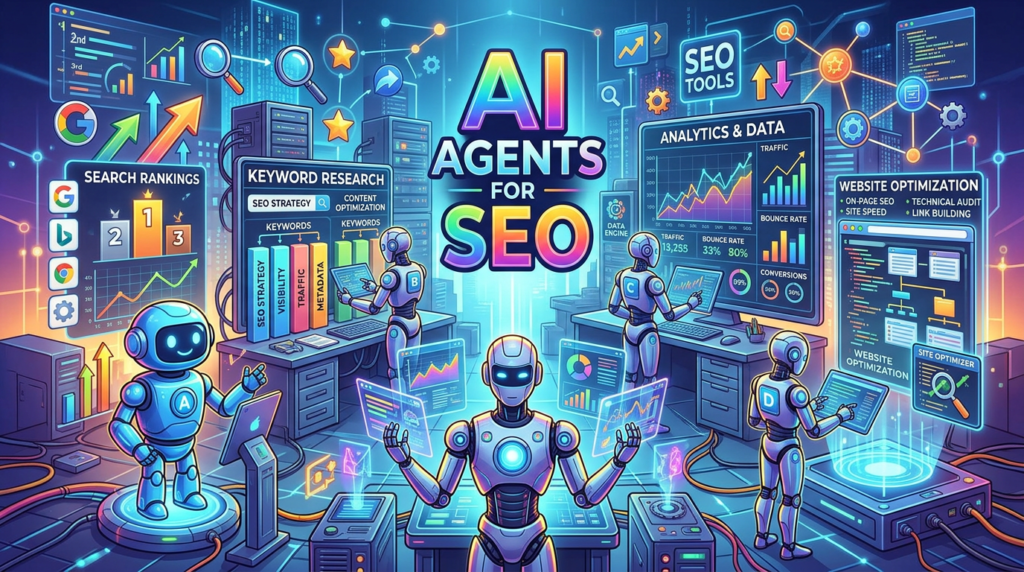
Once the clean data is inside the workspace, the system splits into two parallel specialized agents: the Content Writer Agent and the Semantic Graph Agent.
Agent A: The Content Writer Agent
This agent is injected with a highly restrictive system prompt that overrides all default LLM behavior.
“You are an expert technical SEO copywriter with a background in data science. Your task is to analyze the provided competitor texts and identify missing semantic entities. You must generate new, information-dense paragraphs to be inserted into our existing text. You are strictly forbidden from using conversational fluff such as ‘In conclusion’, ‘Furthermore’, ‘Moreover’, or ‘It is essential to understand’. Get straight to the point. Every sentence must provide proprietary, non-generic value.”
The writer agent outputs its findings in a structured format, specifying exactly which heading (<h2> or <h3>) needs to be modified and what text should be added.
Agent B: The Semantic Graph Agent
Simultaneously, the second agent reads the raw DOM structure of the competitors to extract their structured data. It calculates if the current page lacks granular schema markers. It programmatically generates a clean, valid JSON-LD graph.
Step 4: The Syntax Validation Guardrail
One of the most dangerous points in an autonomous SEO pipeline is the deployment of broken code or malformed data structures. If an LLM accidentally appends a trailing comma or wraps a JSON string in invalid quotation marks, your CMS database can reject the payload, or worse, render a broken layout to real users.
To prevent this, the system routes the output through a Syntax Guardrail Node. This node runs a local script verification:
- It parses the JSON-LD schema through a native
JSON.parse()validation block. - It verifies that all HTML tags opened in the generated content are perfectly closed (
</h2>,</b>, etc.). - If an error is caught, the node captures the raw exception log, attaches it to the original prompt, and loops back to the reasoning layer with a strict demand for immediate correction.
Step 5: The Critic Agent and Self-Reflection Audit
Once the syntax is verified, the content passes to the Critic Agent. This is an isolated LLM instance acting as an internal quality control officer. It checks the generated content against your core business guidelines:
- Keyword Density Analysis: Is the target focus keyword placed within the first 100 words of the text? Is the overall density kept between a safe 0.6% and 1.2% to avoid over-optimization algorithmic penalties?
- Readability Index Evaluation: Does the text read naturally, or does it sound like a machine trying to gaming a machine?
- Length Optimization: Does the added content provide enough depth to bridge the length gap between your page and the top-ranking competitor?
If the Critic approves, it passes a true Boolean flag to the next node. If it flags a violation, it sends the draft back to Agent A with an explicit breakdown of the failure.
Step 6: Automated CMS Deployment & Cache Clearing
With a clean syntax and a stamp of approval from the Critic, the Action Layer executes. It performs a PATCH request to your CMS REST API (e.g., WordPress /wp-json/wp/v2/posts/{id}):
JSON
{
  "content": "\n\n<h2>Integrating MCP Servers into Your Autonomous SEO Architecture</h2>\n<p>To truly achieve agentic autonomy in 2026, implementing Model Context Protocol (MCP) servers is mandatory. These open-standard interfaces allow your LLM core to read secure local file structures and communicate directly with external tracking APIs without intermediate code translations...</p>",
  "meta_description": "Stop manual prompt engineering. Discover how autonomous AI agents for SEO execute multi-step keyword clustering, internal linking, and real-time SERP audits on autopilot."
}
The moment the server responds with a 200 OK status code, a downstream webhook is fired to your caching layer (Cloudflare or LiteSpeed Cache API) to immediately flush the edge cache for that specific URL.
Step 7: Forcing the Search Crawlers (Instant Indexing)
An optimization that sits unindexed for three weeks is a wasted asset. The final step of the autonomous agentic pipeline is to force the search engine spiders to re-crawl the page immediately. The agent fires a POST request to the IndexNow API endpoint, passing the updated URL and your secure domain key. For Google specifically, it sends a request through the Google Indexing API wrapper, moving your updated page to the front of the crawling queue within minutes.
4. GEO (Generative Engine Optimization): The 2026 Search Frontier
As we navigate through 2026, the traditional SEO landscape has fractured. While classic keyword tracking on traditional search engine result pages (SERPs) remains a critical traffic driver, a massive wave of search volume has migrated toward Generative UI Interfaces. Users are asking long-form, complex questions directly to AI platforms like Perplexity, Gemini, SearchGPT, and ChatGPT.
Standard optimization tactics (like optimizing H1 tags and packing page titles with high-volume keywords) are completely ineffective here. These AI models do not read search results the way an index crawler does; they read the web as an interconnected map of concepts. To optimize your brand for this new ecosystem, your AI agents for SEO must execute specialized GEO (Generative Engine Optimization) subroutines.
The Mechanism of LLM Search Ingestion
When a user asks Perplexity or SearchGPT a question like: “What is the most secure, self-hosted automation tool for setting up an enterprise SEO agency?”, the engine performs a real-time Retrieval-Augmented Generation (RAG) cycle. It executes a background vector search, pulls the top 5–10 most relevant pages from its web index, loads them into its massive context window, and synthesizes a direct, comprehensive answer. It attributes its sources using inline hyperlinked citations.
If your site is not selected as one of those core reference nodes in the RAG pipeline, your organic visibility drops to zero for that user session. To ensure your content is consistently pulled into the context window, your SEO agents must continuously tune your digital footprint across three distinct GEO axes:
                  +----------------------------------------+
                  |         GEO OPTIMIZATION AXES          |
                  +----------------------------------------+
                  |                                        |
                  |  [1. Citational Node Mapping]          |
                  |  -> Identifies RAG source clusters     |
                  |                                        |
                  |  [2. Entity-Attribute Alignment]       |
                  |  -> Inject precise JSON-LD connections |
                  |                                        |
                  |  [3. Information-Density Tuning]       |
                  |  -> High fact-to-token ratio           |
                  |                                        |
                  +----------------------------------------+
Axis 1: Citational Node Mapping
AI engines favor domains that are already deeply trusted by the specific niche they are querying. An autonomous GEO agent doesn’t guess where to place backlinks; it dynamically queries the target AI search engines using a matrix of industry-specific prompts.
The agent scrapes the returning responses, extracts every single cited URL, and maps them into a structural graph. It isolates which platforms (e.g., specific subreddits, high-authority niche forums, open-source documentation hubs) are the primary source nodes for that topic. The agent then guides your outreach or digital PR automated workflows to build contextual authority on those exact platforms, essentially injecting your brand directly into the AI’s preferred knowledge pipeline.
Axis 2: Entity-Attribute Alignment
LLMs do not think in words; they think in vectors and structured relationships known as Knowledge Graphs. If the AI model identifies your domain as an entity named “SEO Automation Agency,” it looks for specific, expected attributes linked to that entity in its neural weights—attributes like “reliable,” “API-driven,” “high token efficiency,” and “secure.”
Your AI agents for SEO optimize for this by structuring your technical content around clear entity-attribute definitions. The agent injects precise semantic statements into your pages (e.g., “Our primary system attribute is decentralized execution via self-hosted Docker instances”). Furthermore, it wraps these declarations in highly nested JSON-LD schema matrices, explicitly declaring the sameAs, knowsAbout, and parentOrganization properties to the LLM crawlers.
Axis 3: Information Density and the Fact-to-Token Ratio
AI search models are highly optimized for token efficiency. When a RAG crawler scans an article, it filters out conversational introductions, personal opinions, and filler words to save context window space. If your page has a low Fact-to-Token Ratio (meaning you use 500 words to explain a concept that only requires 50 words of hard data), the AI’s internal reranker will score your page poorly and drop it from the synthesis loop.
Your GEO optimization agent audits your entire portfolio using an information-density calculation. It scans every paragraph, identifies filler sentences, and replaces them with hard facts, raw data points, verified statistics, and concise structural definitions. By maximizing the mathematical density of real information per token, you make your page irresistible to RAG extraction algorithms.
5. Defensive Agentic SEO: Guarding Against the “AI Slop” Penalties
While the power of automation is undeniable, deploying autonomous AI agents for SEO without ironclad guardrails is a direct path to digital destruction. Search engines like Google are fully aware of the massive influx of low-value, programmatic content filling the web. Their algorithmic core updates are explicitly engineered to target and eliminate what the industry refers to as “AI Slop”—mass-produced, shallow text that rehashes existing information without adding any unique perspective or real-world utility.
If your agentic loop simply pulls competitor texts, rewires the phrasing, and re-posts it at a massive scale, your site will eventually trigger a manual action penalty or an algorithmic suppression flag, dropping your organic impressions to absolute zero. To protect your domain portfolio from this risk, your system architecture must integrate strict defensive boundaries.
Rule 1: Eliminating the LLM Fingerprint
Every base language model has a natural statistical bias toward certain word choices, sentence lengths, and structural pacing. This forms an identifiable linguistic footprint. Google’s spam-detection neural networks can easily spot these patterns when looking at a large dataset of pages.
To break this pattern, your agent’s reasoning layer must enforce a strict style guide through a customized post-processing engine. The agent must be instructed to never use generic transition hooks or predictable introductory formulas. You can implement a script-based randomization node that forces variations in sentence structures, alternating between ultra-short, punchy declarations and complex, multi-clause technical statements.
Rule 2: The Mandatory Injection of “Information Gain”
The core metric that protects a site from algorithmic drops in 2026 is Information Gain. This is a mathematical calculation of how much new information your page brings to the internet relative to the top 10 pages already ranking on the SERP. If your page’s information gain score is zero, you are a duplicate node, and you have no structural reason to rank.
Your SEO agent must be linked directly to your proprietary company databases, live internal telemetry, unique customer review logs, or historical case studies. When generating or optimizing an article, the agent must pull unique, un-copyable data points from these secure internal silos and naturally integrate them into the text.
For example, instead of allowing the agent to write a generic sentence like “High-speed trains are efficient,” the system queries an internal SQL database of your actual travel logs and outputs: “Our tracking data from March 2026 shows that utilizing high-speed rail networks cut regional transit times by exactly 42 minutes compared to commercial flights, while dropping carbon overhead to zero.” This is a non-replicable fact that raises your information gain score, safe-guarding your content from programmatic spam filters.
Rule 3: Dynamic Anchor Text Variance and Over-Optimization Protection
When you have an autonomous agent executing internal linking strategies across a portfolio of thousands of pages, it can easily over-optimize. If the agent notices that your core commercial page is targeting the keyword “AI Agents for SEO,” its natural programming might try to inject that exact-match phrase as the anchor text into every single relevant blog post it touches. This uniform behavior triggers algorithmic over-optimization filters, signaling a clear pattern of non-organic internal link manipulation.
To prevent this, the action layer of your internal linking agent must operate on a mathematical probability distribution matrix. Before creating an internal link, the agent must query your CMS database to see the exact current distribution of anchor texts pointing to that target URL. It must maintain a balanced, natural ratio:
- Exact Match Anchors: $\le$ 15% of total internal links.
- Partial Match / Semantic Variations: 45% of total internal links.
- Branded / Contextual Phrases: 40% of total internal links.
If the exact match percentage is creeping too high, the agent automatically shifts its output to generate fluid, sentence-long contextual anchors, mimicking natural human editorial behavior and keeping your link profile safe under the algorithmic radar.
6. Advanced Technical Troubleshooting: Diagnosing Agentic Failures
Even the most meticulously architected AI pipeline will eventually run into runtime exceptions or silent degradation of performance. When managing live systems that connect multiple APIs, data structures, and external firewalls, an experienced webmaster must know how to diagnose and patch errors like a senior systems engineer.
Overcoming Scraping Blocks and Captcha Walls
The most common point of failure for the Perception Layer is getting blocked by advanced edge protection networks like Cloudflare’s Turnstile or Akamai’s behavioral analysis scripts. If your headless browser nodes start returning a 403 Forbidden status code or empty DOM strings, your agentic loop will ingest corrupted data, causing the reasoning layer to output skewed recommendations.
To patch this, you must decouple your scraping node from basic datacenter IP addresses. Your orchestration layer should integrate a premium proxy management middleware that dynamically routes requests through authenticated residential peer-to-peer networks.
Furthermore, you must program the browser instance to mimic human interactions: implement variable scroll delays, inject micro-random movements into the cursor paths, and configure the system to accept cookies and modify its viewport size on every request. If a specific node continues to trigger a block, the agent should catch the error and automatically fall back to a cached search index API (such as Google’s Custom Search API or specialized SERP scrapers) to maintain operational continuity.
Managing JSON Token Leaks and Context Window Overhead
When running continuous loops that ingest massive amounts of text from multiple competitor URLs, your API costs can explode if you are not careful with your Token Economy. Passing raw, un-optimized HTML dumps containing hundreds of lines of inline CSS, JavaScript trackers, and SVG code directly to an LLM node will quickly exhaust its context window and bleed money through unnecessary input token usage.
To fix this leakage, your Perception Layer must execute a strict preprocessing script before passing any data to the reasoning engine. You must implement a purification script that completely purges the DOM tree of non-semantic tags (<script>, <style>, <svg>, <iframe(), noscript).
The text should be tokenized and filtered down using simple sentence extraction algorithms that pull only the raw headers and body paragraph strings. By cleaning the data pipeline before it reaches the brain, you compress your token footprint by up to 85%, reducing computational overhead, lowering API costs, and increasing the overall speed of the execution loop.
Summary: The Final Blueprint for Modern Web Architects
To wrap it all up, folks… We are standing at the absolute pinnacle of a digital revolution. The old world of manual search engine optimization—where you spent your days typing individual commands into a chatbot interface, copying text, and clicking manual buttons inside your CMS dashboard—is gone. It has been replaced by a highly technical, otonom (autonomous) data-driven universe.
+-------------------------------------------------------------------+
|               ENTERPRISE AGENTIC SEO SYSTEM CHECKLIST             |
+-------------------------------------------------------------------+
|                                                                   |
|  [ ] PERCEPTION LAYER: Active API connections to GSC & Live SERP. |
|                                                                   |
|  [ ] SYNTAX GUARDRAIL: Multi-step native JSON parse validation.   |
|                                                                   |
|  [ ] CRITIC NODE: Automated keyword density & anti-fluff filters. |
|                                                                   |
|  [ ] GEO ALGORITHM: Active entity-attribute structure injection.  |
|                                                                   |
|  [ ] PROTECTION: Strict information gain data integration loops.  |
|                                                                   |
+-------------------------------------------------------------------+
If you want your web projects and modern agency frameworks to scale to 7-figures in 2026, you must stop operating as a manual content producer and start operating as a core systems architect. You must build secure, self-correcting pipelines that treat search rankings not as an artistic roll of the dice, but as an optimization formula that can be solved with data, code, and agentic reasoning loops.
Protect your domain portfolios by enforcing strict Information Gain rules, wrap your technical assets in bulletproof semantic schemas, maintain absolute syntax sanitation inside your code blocks, and never let raw, unverified text touch your production database without passing an automated critic audit. Build your automated systems with clean engineering pride, secure your data channels, and step back to let your digital agents manage the SERP battlefield on autopilot.
Top 10 Free AI Tools to Boost Your Small Business Growth in 2026: The Engineering Blueprint for Scalability