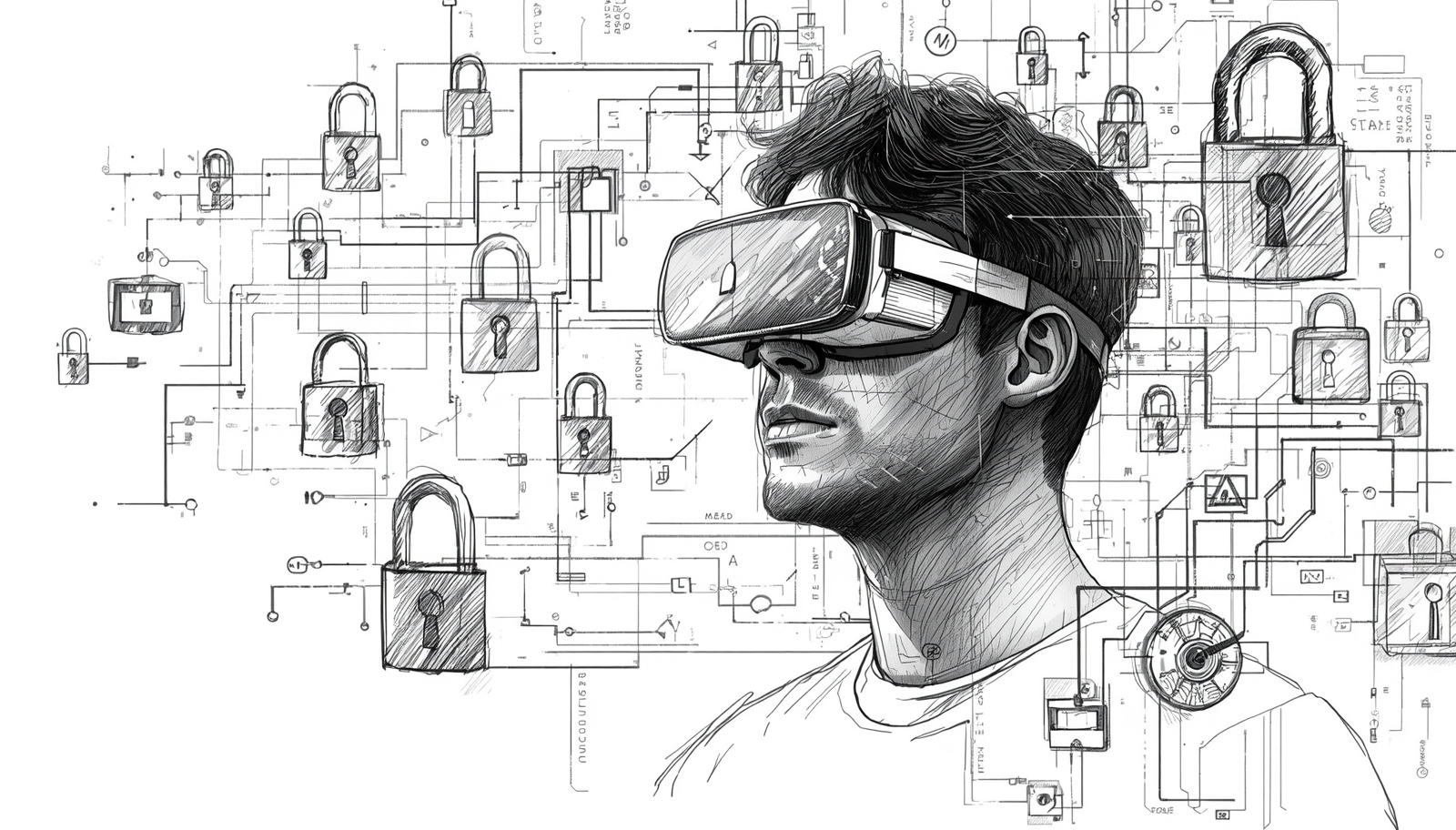
For the last three decades, digital privacy has been an illusion supported by “Terms of Service” agreements. Users surrendered their personal metadata to massive centralized silos, relying on the hollow promise that corporations would treat their information with integrity. This “Privacy by Policy” model has failed catastrophically. As we navigate through 2026, we are witnessing a systemic transition toward Privacy by Mathematics.
In the future of digital privacy, we no longer rely on the fallible intent of a human organization. We rely on immutable cryptographic protocols. If data is processed in a state where it is never decrypted, it cannot be leaked, stolen, or weaponized. This is the era of the Post-Surveillance Web—a technical landscape where privacy is not an elective setting, but a fundamental hardware and protocol-level constraint. This guide dissects the cryptographic pillars that will define the next decade of internet security.
2. The Cryptographic Pillars of the Privacy-First Web
To understand the future, one must master the three emerging technologies that are currently being integrated into the base layer of the internet.

A. Homomorphic Encryption: Computation on Encrypted Datasets
The most revolutionary development in data science is Homomorphic Encryption (HE). Traditionally, to perform an operation on a dataset—such as sorting, calculating an average, or training a machine learning model—the data must be decrypted. Decryption creates a vulnerability; if a hacker breaches the server during this “clear” window, the data is exposed.
Homomorphic encryption allows a server to perform mathematical operations on ciphertexts. The server receives the encrypted data, processes it, and generates an encrypted result. When the client receives the result and decrypts it, the answer matches the result of operations performed on the plaintext. The server never “sees” the data it processed. In 2026, this is becoming the standard for healthcare AI and financial auditing, where data sensitivity is absolute.
B. Zero-Knowledge Proofs (ZKP): Mathematical Truths Without Data Disclosure
The current internet operates on a “Provide Everything” model. To prove you are over 21, you upload a passport photo, revealing your name, birthdate, ID number, and address. This is a massive privacy liability.
Zero-Knowledge Proofs (ZKP) allow one party (the prover) to convince another party (the verifier) that a statement is true, without revealing any information beyond the validity of the statement itself.
In the future web, you will not “log in” by handing over credentials. You will provide a ZKP token that proves:
- You are over 18.
- You have sufficient funds in your wallet.
- You are a verified resident of a specific region. The service provider receives a “True” signal and nothing else. No data is stored, no databases are breached, and no user tracking occurs.
C. Decentralized Identity (DID) and Self-Sovereign Identity (SSI)
The “Login with Google/Facebook” era is a centralized bottleneck. It allows tech giants to build a 360-degree profile of every user’s activity across the entire web. The future belongs to Decentralized Identity (DID).
In an SSI architecture, identity credentials (diplomas, government IDs, professional certifications) are stored in an encrypted, user-controlled digital wallet. When you interact with a web service, you present a verifiable credential. The service checks your digital signature against a public key ledger to confirm authenticity. The data remains on your device (or in your private cloud), not on the service provider’s servers. You are the sole curator of your digital footprint.
3. Federated Learning: AI Training Without Data Exfiltration
One of the greatest tensions in 2026 is the conflict between the need for advanced AI training and the need for user privacy. If an AI requires billions of data points to improve, must it constantly vacuum up our personal content?
Federated Learning offers a technical solution:
- Distributed Training: Instead of sending your personal data to a central server, the central server sends a “model” to your device.
- Local Execution: The model trains on your local device, learning from your specific usage patterns, behavior, and data.
- Encrypted Aggregation: Your device sends only the mathematical updates (weight changes) to the central server, not the data itself.
- Collective Intelligence: The server aggregates these weight changes from millions of devices to improve the global model, ensuring that the model is smarter without the central server ever “seeing” a single private file from any user.
4. Hardware-Level Privacy: Trusted Execution Environments (TEE)
Software-level privacy is insufficient if the hardware is compromised. The future of digital privacy is rooted in Trusted Execution Environments (TEE)—secure, isolated areas inside a computer processor.
When an application runs inside a TEE, it is shielded from the rest of the system. Even if the Operating System (OS) itself is compromised by malware, the data inside the TEE remains encrypted and inaccessible. This is the hardware equivalent of a digital vault. In 2026, we are seeing the mass adoption of TEE-enabled mobile processors, ensuring that our biometric keys and encryption tokens are physically separated from the general-purpose compute environment.
5. Differential Privacy: Protecting Aggregate Insights
How do we conduct global research without compromising individuals? Differential Privacy is a mathematical framework used by tech giants and governments alike to ensure that individual contributions to a dataset cannot be reverse-engineered.
It works by injecting a calculated amount of “statistical noise” into the dataset. While the noise is sufficient to mask the identity of any single individual (making it impossible to isolate “who” performed “what”), the statistical trends of the collective dataset remain accurate. This allows researchers to study disease outbreaks or global economic trends without knowing the exact medical or financial history of any single citizen.
6. The Web3 Privacy Infrastructure: Decentralized Storage and Encrypted Comms
As we look toward 2030, the reliance on centralized server farms is diminishing. We are witnessing the emergence of a decentralized web (Web3) characterized by two key architectural shifts:
A. Decentralized File Storage (IPFS & Arweave)
Traditional centralized cloud storage is a “honey pot” for hackers. Decentralized storage breaks your files into thousands of encrypted shards, distributes them across thousands of independent nodes globally, and uses blockchain protocols to verify their integrity. No single server owns your data, and no single administrator can grant access to your private files.
B. End-to-End Encryption (E2EE) by Default
E2EE is evolving from a specialized messaging tool to a fundamental protocol requirement. In the future web, any communication—whether it is a file transfer, a video call, or a database query—will be encrypted at the source and decrypted only at the destination. The “man-in-the-middle” will be structurally removed from the pipeline.
7. The Regulatory and Ethical Landscape: The “Rights to Erasure”
Technology is moving faster than legislation, but the intersection of the two will define the late 2020s.
A. The “Right to be Forgotten” in the Age of AI
If an AI model is trained on data that is subsequently retracted or deleted by the original owner, how does the model “unlearn” that specific piece of information? This is the “Machine Unlearning” problem. The future of privacy law will dictate that AI developers must provide a mechanism for data extraction—an audit trail of what data influenced which model weights—allowing for the surgical removal of private data from the neural network’s architecture.
B. Privacy as a Global Currency
As data becomes more expensive to harvest and more difficult to secure, we are moving toward a future where “Data Sovereignty” is a tradable commodity. You will be able to monetize your own data by sharing it with researchers in a privacy-preserving (ZKP/Homomorphic) environment, receiving compensation directly, bypassing the brokers who currently profit from your digital trail.

8. Engineering the Future: A Roadmap for Digital Architects
If you are a developer, a systems architect, or a webmaster looking to build for the privacy-centric future, your strategy must evolve immediately.
Architectural Action Plan:
- Adopt Zero-Trust Networking: Stop assuming that internal traffic is safe. Treat every micro-service communication as if it were crossing the open internet.
- Minimize Data Collection (Data Minimization): If you don’t collect the data, you don’t have to secure it. Only store what is absolutely required for the function of the application.
- Implement Privacy-Preserving Analytics: Move away from client-side tracking pixels that leak user behavior to third-party ad networks. Use self-hosted, anonymous analytic suites that do not track IP addresses or user fingerprints.
- Prioritize Cryptographic Auditing: Ensure your data pipelines are built to support future integration of homomorphic encryption libraries as they become more compute-efficient.
9. Conclusion: Restoring Digital Sovereignty
The future of digital privacy is not about retreating to the analog past. It is about evolving into a technical future where we can harness the full power of machine learning, big data, and global connectivity without sacrificing our autonomy.
We are shifting from a surveillance-based economic model to one where the individual is the gatekeeper of their own digital essence. By moving privacy from the “legal” layer to the “protocol” layer, we are ensuring that the architecture of the web is inherently resistant to corruption, theft, and unauthorized exploitation.
The internet of the future will be encrypted, decentralized, and governed by mathematical proofs rather than corporate mandates. As architects of this digital future, our mandate is clear: build for sovereignty, prioritize the individual, and ensure that the infrastructure of the web serves humanity, not the surveillance machine.
The transition to a privacy-first web is no longer a theoretical debate—it is an engineering imperative. As developers and SEO specialists, our job is to ensure that our platforms are not just optimized for search, but optimized for the user’s right to exist in the digital sphere without being harvested, tracked, or exploited. The tools are here; the protocols are maturing. It is time to build.AI Agents for SEO: How to Find and Fix Orphan Pages Using Autonomous Link Graphs and Outbound Authority Protocols 2027